
In today’s digital age, children often depend on calculators and mobile devices for even simple calculations. While technology is helpful, developing strong mental math skills remains one of the most valuable abilities a child can acquire.
Mental math is the ability to perform calculations quickly and accurately in the mind without using paper, calculators, or other tools. It not only improves mathematical abilities but also strengthens overall brain development, memory, concentration, and logical thinking. Studies and educational programs consistently show that children who practice mental math develop stronger cognitive skills and better academic performance.
In this article, we will explore the top mental math benefits for children and why parents should encourage their kids to learn mental math from an early age Mental Math Benefits for Children.
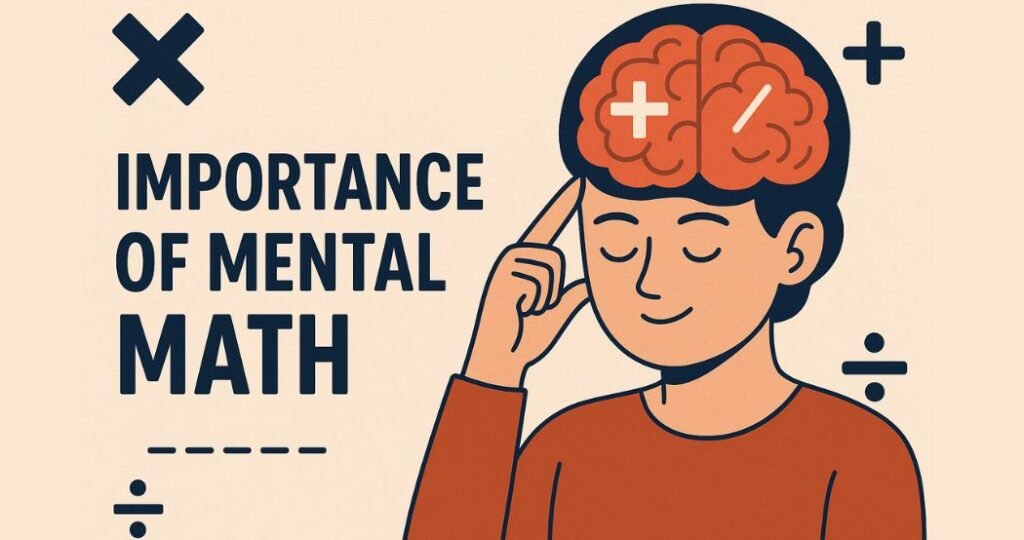
What is Mental Math?
Mental math refers to solving mathematical problems using brainpower rather than external tools. Children learn techniques such as number visualization, estimation, decomposition, and pattern recognition to perform calculations rapidly Mental Math Benefits for Children.
Programs like Abacus and Vedic Maths help children develop advanced mental calculation abilities while improving their overall cognitive development.
Top 10 Mental Math Benefits for Children
1. Improves Concentration and Focus
Mental math requires children to pay close attention to numbers and calculation steps. Regular practice trains the brain to focus for longer periods Mental Math Benefits for Children.
Children who engage in mental math activities often show improved classroom attention, better listening skills, and enhanced learning capacity across subjects.
Benefits:
- Better concentration in studies
- Increased attention span
- Improved classroom performance
2. Enhances Memory Power
Mental calculations require children to hold numbers and operations in their minds. This process strengthens working memory and long-term retention Mental Math Benefits for Children.
As memory improves, children find it easier to remember formulas, concepts, and academic information.
Benefits:
- Stronger memory retention
- Faster information recall
- Better academic performance
3. Develops Faster Calculation Skills
One of the most visible benefits of mental math is increased calculation speed. Children can solve arithmetic problems quickly without relying on calculators Mental Math Benefits for Children.
This speed becomes highly beneficial during school exams, competitive tests, and daily problem-solving situations.
Benefits:
- Quick addition and subtraction
- Faster multiplication and division
- Improved exam performance
4. Builds Strong Problem-Solving Skills
Mental math teaches children how to break complex problems into smaller, manageable steps. This strengthens analytical thinking and problem-solving abilities.
Children learn to approach challenges logically instead of memorizing solutions.
Benefits:
- Better reasoning ability
- Improved decision-making
- Strong analytical skills
5. Boosts Confidence and Self-Esteem
When children can solve calculations quickly and accurately, they gain confidence in their abilities.
Success in mathematics often leads to greater participation in class, improved self-belief, and a positive attitude toward learning.
Benefits:
- Increased self-confidence
- Reduced fear of mathematics
- Positive learning mindset

6. Strengthens Logical Thinking
Mental math helps children understand relationships between numbers and patterns. Instead of memorizing formulas, they learn the logic behind calculations Mental Math Benefits for Children.
Logical thinking skills developed through mental math also support subjects like science, coding, and technology.
Benefits:
- Better reasoning skills
- Strong numerical understanding
- Improved STEM learning
7. Reduces Dependence on Calculators
Children who practice mental math become more independent learners. They can perform everyday calculations without immediately reaching for a calculator Mental Math Benefits for Children.
This develops greater confidence and practical life skills.
Benefits:
- Independent thinking
- Better number sense
- Greater mathematical confidence
8. Improves Academic Performance
Mental math skills extend beyond mathematics. Enhanced memory, focus, and logical thinking contribute to improved performance across multiple subjects Mental Math Benefits for Children.
Many educational programs report that students practicing mental math show overall academic improvement.
Benefits:
- Better grades
- Improved learning efficiency
- Higher academic achievement
9. Enhances Brain Development
Mental math exercises stimulate multiple areas of the brain simultaneously. Visualization techniques and rapid calculations help strengthen neural connections and cognitive flexibility Mental Math Benefits for Children.
Benefits:
- Improved brain function
- Better information processing
- Enhanced creativity
10. Prepares Children for Future Success
Mental math develops essential life skills such as critical thinking, quick decision-making, concentration, and confidence.
These abilities help children succeed not only in academics but also in future careers and everyday life Mental Math Benefits for Children .
Benefits:
- Better career readiness
- Strong decision-making skills
- Lifelong learning abilities
Why Parents Should Encourage Mental Math Learning
Parents often focus on academic scores, but mental math offers much more than better grades. It helps children develop the cognitive foundation necessary for lifelong success.
Programs such as Abacus, Vedic Maths, and brain development training can significantly improve a child’s concentration, memory, and problem-solving abilities.
How Brain Skool Helps Children Master Mental Math
At Brain Skool, children learn advanced mental math techniques through engaging and scientifically designed programs. Brain Skool’s Abacus and Vedic Maths courses help children:
- Improve concentration and memory
- Develop lightning-fast calculation skills
- Enhance logical thinking
- Build confidence in mathematics
- Achieve better academic results
Brain Skool’s holistic brain development approach focuses on nurturing future-ready learners with strong cognitive abilities.
Conclusion
Book Your FREE Demo Class
Fill this quick form — our team will email & call you back within 24 hours.
Mental math is far more than a mathematical skill—it is a powerful brain-training tool that helps children develop focus, memory, confidence, and problem-solving abilities.
By introducing mental math at an early age, parents can help their children build a strong foundation for academic success and lifelong learning. Whether through Abacus, Vedic Maths, or structured mental math programs, investing in these skills today can create smarter, more confident learners tomorrow Mental Math Benefits for Children.

Frequently Asked Questions (FAQ)
1. What are the benefits of mental math for children?
Mental math improves concentration, memory, calculation speed, logical thinking, problem-solving skills, and overall academic performance.
2. At what age should children start learning mental math?
Most experts recommend introducing mental math concepts between 4 and 7 years of age, depending on the child’s readiness and interest.
3. Does mental math improve brain development?
Yes. Mental math stimulates various cognitive functions, including memory, focus, visualization, and analytical thinking, contributing to overall brain development.
4. Is mental math better than using calculators?
Mental math develops critical thinking, number sense, and problem-solving skills, whereas calculators simply provide answers. Both have their place, but mental math strengthens cognitive abilities.
5. How does mental math improve concentration?
Mental calculations require children to maintain focus while processing numbers, which naturally improves attention span and concentration levels.
6. Can mental math help children perform better in school?
Yes. Improved memory, concentration, and logical thinking gained through mental math often translate into better academic performance across multiple subjects.
7. What is the difference between Abacus and Mental Math?
Abacus is a learning tool used to develop mental math skills. Over time, children visualize the abacus mentally and perform calculations without the physical device.
8. How often should children practice mental math?
Daily practice of 10–20 minutes is generally effective for building strong mental math abilities and maintaining consistent progress.
9. Can mental math reduce fear of mathematics?
Yes. As children become faster and more accurate in calculations, they gain confidence and develop a positive attitude toward mathematics.
10. Which is the best mental math program for kids?
Programs such as Abacus and Vedic Maths offered by Brain Skool India are designed to improve memory, concentration, and calculation skills while supporting overall brain development.
Abacus Learning in India: What Parents Should Know
Across India, abacus training has become one of the most trusted after-school programs for children aged 4 to 14. Unlike rote tuition, abacus works on the root skills – visualisation, concentration and speed – which is why children who complete even 2-3 levels show visible improvement in school maths. At Brain Skool, every abacus batch is led by a certified trainer, follows a level-wise curriculum with assessments, and students participate in our national Abacus Olympiad each year. Classes run online across India and offline in Jaipur.
Quick Facts
- Best starting age: 4-8 years (but up to 14 works well)
- Duration: about 3 months per level with practice
- Format: live online classes or Jaipur centre
- First step: a 100% free demo class
🧠 Book a FREE Demo Class for Your Child
Abacus • Vedic Maths • Coding • Robotics • Memory Training — Ages 4 to 16, Online Classes Across India
💬 WhatsApp Us Now 💬 WhatsApp Us Now 📝 Enquire NowOr call us: +91 80946 42826 / +91 89497 08793