
Introduction
In today’s competitive academic environment, parents are constantly looking for ways to improve their child’s mathematical abilities, concentration, memory, and overall cognitive development. Abacus vs Vedic Maths Two of the most popular programs that help children excel in mathematics are Abacus and Vedic Maths.
But the question remains:
Which is better for your child—Abacus or Vedic Maths?
The answer depends on your child’s age, learning style, academic goals, and developmental needs. While both methods help improve calculation speed and mathematical confidence, they work in very different ways Abacus vs Vedic Maths.
In this comprehensive guide, we’ll compare Abacus and Vedic Maths in detail, explore their benefits, identify the ideal age to start each program, and help you choose the best option for your child Abacus vs Vedic Maths.
What Is Abacus?
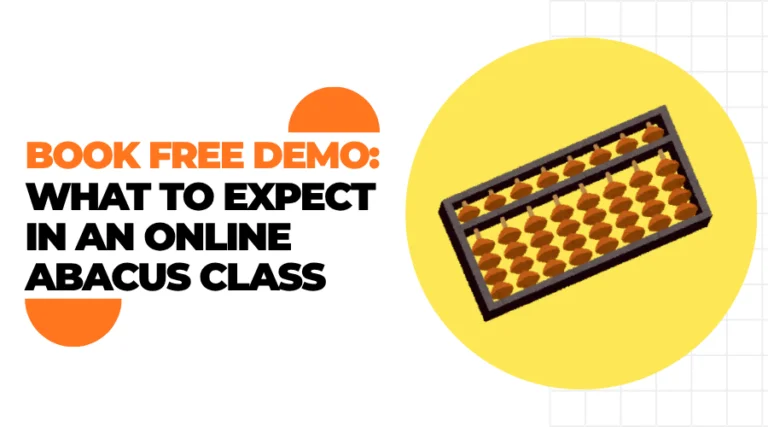
Abacus is an ancient mathematical tool used to perform arithmetic calculations using beads on rods. Over time, children learn to visualize the Abacus in their minds and perform complex calculations mentally without using a physical tool.
Modern Abacus training focuses not only on mathematics but also on cognitive development, memory enhancement, concentration, visualization, and mental agility.
Benefits of Abacus Learning
1. Improves Memory
Abacus students use visualization techniques that strengthen memory retention and recall abilities.
2. Enhances Concentration
Children must stay focused while visualizing and manipulating beads mentally, improving attention span significantly.
3. Develops Mental Calculation Skills
Students learn to solve calculations quickly without relying on calculators.
4. Boosts Brain Development
Abacus engages both the left and right hemispheres of the brain, promoting balanced cognitive development.
5. Increases Confidence
Fast and accurate calculations improve a child’s self-esteem and classroom participation.
6. Improves Academic Performance
Better concentration and memory often lead to stronger overall academic results.
What Is Vedic Maths?
Vedic Maths is a system of mathematical techniques and shortcuts derived from ancient Indian mathematical principles. It uses formulas, tricks, and mental strategies to simplify complex calculations Abacus vs Vedic Maths.
Instead of visualizing numbers, students learn efficient methods to solve mathematical problems faster.
Benefits of Vedic Maths
1. Faster Calculations
Students can solve arithmetic problems in significantly less time.
2. Improves Accuracy
Shortcut methods reduce calculation errors when applied correctly.
3. Enhances Problem-Solving Skills
Students develop alternative approaches to solving mathematical problems.
4. Helps in Competitive Exams
Speed and efficiency are highly beneficial in entrance exams and competitive tests.
5. Makes Mathematics Enjoyable
Students often find Vedic Maths more engaging than traditional calculation methods.
Abacus vs Vedic Maths: Key Differences
| Feature | Abacus | Vedic Maths |
|---|---|---|
| Learning Method | Visualization & Bead Movement | Mathematical Shortcuts |
| Ideal Age | 4–14 Years | 10+ Years |
| Brain Development | Excellent | Moderate |
| Memory Enhancement | Excellent | Good |
| Concentration Improvement | Excellent | Good |
| Calculation Speed | Excellent | Excellent |
| Visualization Skills | Very High | Low |
| Competitive Exam Support | Moderate | Excellent |
| Creativity Development | Strong | Moderate |
| Mental Arithmetic | Excellent | Excellent |
Abacus vs Vedic Maths: Which Improves Brain Development More?
When it comes to cognitive development, Abacus has a clear advantage.
Abacus training requires children to imagine bead movements mentally. This process activates multiple areas of the brain simultaneously, including memory, visualization, concentration, and reasoning skills Abacus vs Vedic Maths.
As a result, children often experience improvements in:
- Focus
- Listening skills
- Observation
- Mental agility
- Information retention
Vedic Maths primarily focuses on calculation techniques rather than whole-brain development.
Winner: Abacus
Which Program Improves Calculation Speed Faster?
Both Abacus and Vedic Maths significantly improve speed.
However, the approach is different:
Abacus
Children visualize numbers and perform calculations mentally.
Vedic Maths
Children apply mathematical shortcuts and formulas.
For advanced arithmetic calculations and competitive exams, Vedic Maths often provides faster solutions.
Winner: Vedic Maths
Abacus vs Vedic Maths for Different Age Groups
Ages 4–7
At this stage, children are developing basic numerical understanding.
Recommended:
Abacus
Why?
- Builds a strong mathematical foundation
- Improves concentration
- Enhances memory
- Develops visualization skills
Ages 8–10
Children begin handling more complex mathematical concepts.
Recommended:
Abacus + Introduction to Vedic Maths
This combination helps develop both cognitive abilities and calculation speed.
Ages 11–16
Older students often face increasing academic pressure and competitive examinations.
Recommended:
Vedic Maths
Benefits include:
- Faster calculations
- Better exam performance
- Improved efficiency
- Stronger mathematical confidence
Can Children Learn Both Abacus and Vedic Maths?
Absolutely.
In fact, many education experts recommend learning both programs sequentially.
Step 1: Start with Abacus
Abacus builds:
- Memory
- Concentration
- Visualization
- Mental arithmetic skills
Step 2: Move to Vedic Maths
Vedic Maths enhances:
- Calculation speed
- Problem-solving techniques
- Exam performance
- Mathematical efficiency
This combination offers the best of both worlds.
Why More Parents Are Choosing Abacus First
Parents today are not only looking for better mathematics skills but also overall brain development.
Abacus helps children improve:
- Focus
- Memory
- Confidence
- Learning ability
- Classroom participation
Many parents notice positive behavioral and academic changes within a few months of consistent practice.
Why Students Prefer Vedic Maths
Students preparing for competitive examinations often choose Vedic Maths because it saves time during calculations.
Popular exams where Vedic Maths can be beneficial include:
- Olympiads
- NTSE
- SAT
- CAT
- SSC
- Banking Exams
- Government Recruitment Exams
The ability to solve questions quickly often provides a competitive advantage.
Common Mistakes Parents Make
Choosing Based Only on Speed
Many parents focus only on faster calculations while ignoring cognitive development.
Starting Vedic Maths Too Early
Young children may struggle to understand advanced shortcuts without a strong foundation.
Ignoring Consistent Practice
Both Abacus and Vedic Maths require regular practice for maximum results.
Expecting Instant Results
Brain development and skill enhancement take time and consistency.
Why Brain Skool Is a Trusted Choice for Abacus and Vedic Maths
At Brain Skool, the focus goes beyond mathematics. The programs are designed to enhance a child’s overall intellectual growth through structured learning methodologies.
Why Parents Choose Brain Skool
✅ Certified and Experienced Trainers
✅ Online & Offline Learning Options
✅ Child-Friendly Curriculum
✅ Focus on Memory and Concentration
✅ Brain Development-Oriented Training
✅ Interactive Learning Environment
✅ Personalized Attention
✅ Free Demo Classes Available
Explore Brain Skool Programs
- Home: Brain Skool Official Website
- Abacus Program: Abacus Classes for Kids
- Contact Us: Brain Skool Contact Page
Final Verdict: Abacus or Vedic Maths?
The best choice depends on your child’s age and learning objectives.
Choose Abacus If:
- Your child is between 4 and 10 years old.
- You want to improve memory and concentration.
- You want overall brain development.
- You want stronger visualization skills.
Choose Vedic Maths If:
- Your child is above 10 years old.
- You want faster calculations.
- Your child is preparing for competitive exams.
- Mathematical speed is the primary goal.
Best Recommendation
For maximum benefits, start with Abacus and later introduce Vedic Maths.
Abacus develops the brain.
Vedic Maths enhances speed.
Together, they create a powerful foundation for academic excellence and lifelong mathematical confidence.
Frequently Asked Questions (FAQs)
Abacus vs Vedic Maths: Side-by-Side Comparison Table
| Feature | Abacus | Vedic Maths |
|---|---|---|
| Origin | Ancient counting tool; modern soroban method from Japan | System compiled by Swami Bharati Krishna Tirtha, book published 1965 |
| How it works | Moving beads, later visualising beads in the mind | 16 sutras (formulas) and 13 sub-sutras for shortcut calculation |
| Best starting age | 5-12 years | 10 years and above (after tables are known) |
| Main skills | Concentration, visualisation, mental calculation, number sense | Speed, flexible thinking, checking answers, exam shortcuts |
| Course length | About 2-2.5 years (8 levels) | About 6-12 months |
| Needs a tool? | Yes at first, then mental | No, pen and paper only |
| Helps most in | Primary school maths, olympiads, focus | Class 6-12 maths, SSC, banking, CAT and other speed tests |
| Research | 3-year randomised trial in Vadodara showed arithmetic gains (Barner et al., 2016) | Fewer formal studies; widely used for speed in competitive exams |
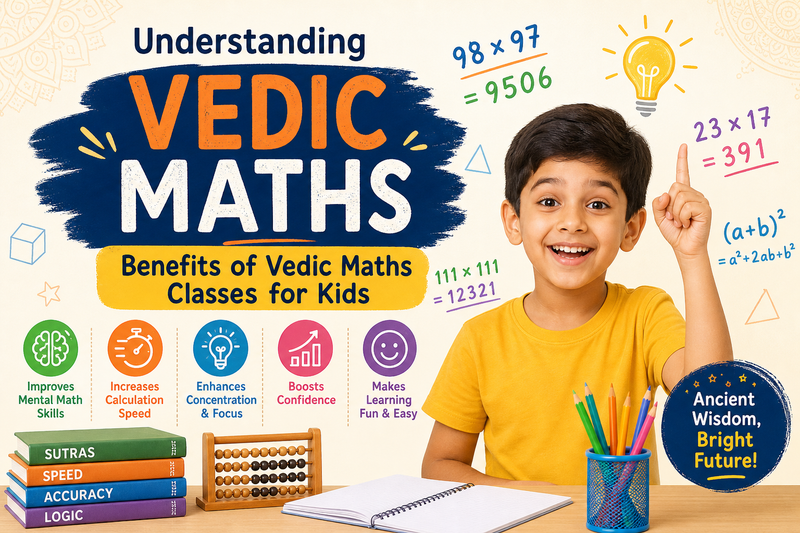
Same Problem, Two Methods: 98 x 97
Book Your FREE Demo Class
Fill this quick form — our team will email & call you back within 24 hours.
Vedic Maths (Nikhilam sutra, “all from 9 and the last from 10”):
- Both numbers are close to 100. 98 is 2 less, 97 is 3 less.
- Cross-subtract: 98 – 3 = 95 (left part).
- Multiply the differences: 2 x 3 = 06 (right part, two digits).
- Answer: 9506.
Abacus / mental abacus: the child multiplies digit by digit on the rods (98 x 7, then 98 x 90) and adds the partial products by moving beads, either on the tool or in the mind. Advanced abacus students do this in a few seconds, but the method is general and does not rely on the numbers being near 100.
This shows the core difference: Vedic Maths gives clever shortcuts for special patterns; abacus builds a general mental calculator plus concentration.
More Vedic Maths Examples Children Love
| Trick | Example | How |
|---|---|---|
| Squares ending in 5 | 65² = 4225 | 6 x 7 = 42, then write 25 |
| Multiply by 11 | 53 x 11 = 583 | Write 5, then 5 + 3 = 8, then 3 |
| Subtract from 1000 | 1000 – 357 = 643 | All from 9 (3→6, 5→4), last from 10 (7→3) |
| Multiply by 5 | 48 x 5 = 240 | Half of 48 is 24, add a zero |
| Check with digit sums | 23 x 14 = 322? | Digit sums 5 x 5 = 25 → 7; 3+2+2 = 7, so it checks |
The 16 Vedic Maths Sutras (Names and Use)
| # | Sutra | Meaning | Used for |
|---|---|---|---|
| 1 | Ekadhikena Purvena | By one more than the previous one | Squares ending in 5, recurring decimals |
| 2 | Nikhilam Navatashcaramam Dashatah | All from 9 and the last from 10 | Multiplying near bases (10, 100, 1000), subtraction |
| 3 | Urdhva-Tiryagbhyam | Vertically and crosswise | General multiplication |
| 4 | Paravartya Yojayet | Transpose and adjust | Division, equations |
| 5 | Shunyam Samyasamuccaye | When the sum is the same, that sum is zero | Special equations |
| 6 | (Anurupye) Shunyamanyat | If one is in ratio, the other is zero | Simultaneous equations |
| 7 | Sankalana-vyavakalanabhyam | By addition and subtraction | Simultaneous equations |
| 8 | Puranapuranabhyam | By completion or non-completion | Quadratic and cubic equations |
| 9 | Chalana-Kalanabhyam | Differences and similarities | Calculus-type problems, factorising |
| 10 | Yavadunam | Whatever the extent of its deficiency | Squares and cubes near a base |
| 11 | Vyashtisamanstih | Part and whole | Factorisation |
| 12 | Shesanyankena Charamena | The remainders by the last digit | Decimal expansion of fractions |
| 13 | Sopaantyadvayamantyam | The ultimate and twice the penultimate | Special equations |
| 14 | Ekanyunena Purvena | By one less than the previous one | Multiplying by 9, 99, 999 |
| 15 | Gunitasamuchyah | The product of the sum equals the sum of the product | Checking factorisation |
| 16 | Gunakasamuchyah | The factors of the sum equal the sum of the factors | Factorisation checks |
A note for parents: despite the name, historians point out that these sutras are not found in the original Vedas; they were composed and published by Bharati Krishna Tirtha in the 20th century. That does not reduce their usefulness: the methods are mathematically correct and genuinely speed up calculation.
Decision Guide: Which Should Your Child Learn?
| Your child is… | Recommendation |
|---|---|
| 5-9 years, finds numbers hard or loses focus | Abacus first |
| 8-10 years, knows tables up to 10 | Abacus, then add Vedic Maths later |
| 11-14 years, good at basics but slow in exams | Vedic Maths |
| Preparing for SSC, banking, CAT or olympiads | Vedic Maths for speed |
| Wants both concentration and speed long term | Abacus (age 5-10) followed by Vedic Maths (age 10+) |
Explore each program: Abacus classes · Vedic Maths classes · Top 25 Vedic Maths tricks · Abacus levels chart.
Not sure which suits your child? A free demo includes a short assessment. Book a free demo class →
More Questions Parents Ask
What is the main difference between abacus and Vedic maths?
Abacus is a bead tool that is later visualised in the mind to build a general mental calculator, focus and number sense, best for ages 5 to 12. Vedic maths is a set of 16 sutras that give shortcut methods for fast calculation, best from age 10 and for competitive exams.
Is Vedic maths really from the Vedas?
The 16 sutras were compiled by Swami Bharati Krishna Tirtha and published in 1965. Historians note they are not found in the original Vedas, but the methods are mathematically correct and useful for speed.
Which is better for competitive exams, abacus or Vedic maths?
Vedic maths is more directly useful for SSC, banking, CAT and similar speed-based exams because its shortcuts work on paper with large numbers.
Can a child do abacus and Vedic maths together?
It is better to learn them one after the other: abacus between ages 5 and 10, then Vedic maths from about 10 onwards, so the child does not mix the methods.
1. Which is better, Abacus or Vedic Maths?
Both are beneficial. Abacus is better for brain development, memory, and concentration, while Vedic Maths is excellent for improving calculation speed and exam performance.
2. What is the ideal age to start Abacus?
Most children can begin Abacus training between the ages of 4 and 14, with ages 5–10 often considered ideal.
3. At what age should a child learn Vedic Maths?
Vedic Maths is generally recommended for children aged 10 years and above.
4. Does Abacus improve memory?
Yes. Abacus uses visualization techniques that help strengthen memory and concentration skills.
5. Can a child learn both Abacus and Vedic Maths?
Yes. Learning Abacus first and Vedic Maths later is often considered the most effective approach.
6. Is Vedic Maths useful for competitive exams?
Absolutely. Vedic Maths helps students solve calculations faster and manage exam time more efficiently.
7. How long does it take to see results from Abacus training?
Many children show noticeable improvements in concentration and calculation skills within a few months of regular practice.
8. How can I enroll my child at Brain Skool?
You can visit the official website, book a free demo class, and speak with an academic counselor to choose the most suitable pr
Lead Generation CTA
Give Your Child the Advantage They Deserve!
Book a FREE Demo Class today and discover how Brain Skool can help your child improve memory, concentration, confidence, and mathematical skills through expert-led Abacus and Vedic Maths programs.
👉 Visit: Brain Skool
👉 Enquire Now: Contact Brain Skool
Abacus Learning in India: What Parents Should Know
Across India, abacus training has become one of the most trusted after-school programs for children aged 4 to 14. Unlike rote tuition, abacus works on the root skills – visualisation, concentration and speed – which is why children who complete even 2-3 levels show visible improvement in school maths. At Brain Skool, every abacus batch is led by a certified trainer, follows a level-wise curriculum with assessments, and students participate in our national Abacus Olympiad each year. Classes run online across India and offline in Jaipur.
Quick Facts
- Best starting age: 4-8 years (but up to 14 works well)
- Duration: about 3 months per level with practice
- Format: live online classes or Jaipur centre
- First step: a 100% free demo class
🧠 Book a FREE Demo Class for Your Child
Abacus • Vedic Maths • Coding • Robotics • Memory Training — Ages 4 to 16, Online Classes Across India
📝 Book Free Demo 📝 Enquire NowOr call us: +91 80946 42826 / +91 89497 08793